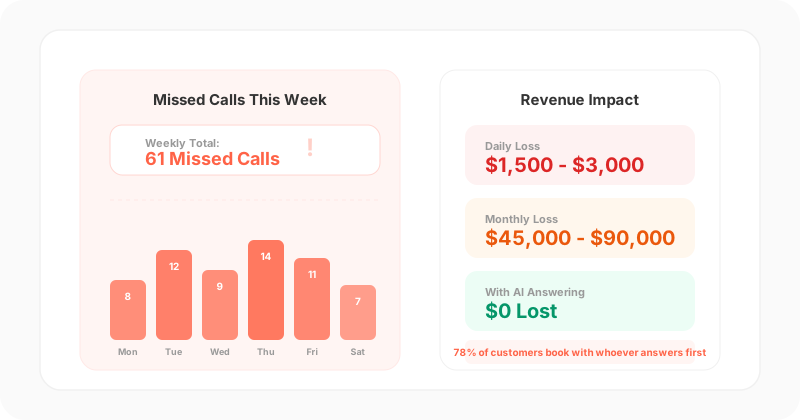
AI appointment scheduling helps businesses capture every inbound lead by answering calls instantly and automatically booking appointments. Most small businesses miss a significant percentage of calls, which directly impacts revenue. In this guide, we break down how many calls you're likely missing, what it's costing you, and how to fix it.
You're Not Missing a Few Calls. You're Missing Revenue.
- Most businesses assume they miss "a couple" calls a day
- In reality, 20% to 40% of inbound calls go unanswered
That's not a small issue. That's lost revenue every single day.
What a Missed Call Actually Means
- A customer needed something immediately
- They didn't get an answer
- They moved on to the next business
You didn't lose a call. You lost a booked job.
The Math Most Businesses Avoid
Let's make this real:
- 10 missed calls per day
- ₹12,000 to ₹24,000 average job
That's:
- ₹1,20,000 to ₹2,40,000 per day
- ₹36,00,000 to ₹72,00,000 per month
Most businesses never calculate this. They just stay busy and assume things are fine.
Why Businesses Miss Calls
This isn't about effort. It's about how operations are structured.
Peak Time Overload
- Calls spike when your team is busiest
- Staff is already engaged with customers
After Hours
- Nights and weekends still generate demand
- No one is available to answer
Multitasking Breakdown
Front desk is handling:
- In-person customers
- Admin work
- Phone calls
Something always gets missed.
The Real Problem: Response Time
- Customers don't wait
- Most won't leave a voicemail
- They move to the next option
- Speed is the deciding factor.
What High-Performing Businesses Do Differently
They don't rely on people to catch every call. They:
- Answer instantly
- Book immediately
- Remove friction from scheduling
The Shift: From Call Handling to Call Capture
Old model:
- Try to answer every call
New model:
- Ensure every call gets answered instantly
This is a systems problem, not a staffing problem.
Quick Self-Check
- How many calls go to voicemail daily?
- How many callbacks happen within 5 minutes?
- How many leads never get a response?
If you don't know the answer, you have a gap.
What Fixing This Looks Like
- Every call is answered instantly
- Booking happens during the call
- No manual follow-up required
Learn how this works in our guide on AI appointment scheduling.
See What You're Missing
- Calculate how many calls you're missing
- Estimate what that's costing you
Most businesses underestimate this by 5 to 10 times.
Stop losing revenue to missed calls
Start your free trial today and let AI answer every call, book every appointment, and capture every lead automatically.
Frequently Asked Questions
Do missed calls really impact revenue that much?
Yes. In service businesses, calls represent active buying intent.
Can this be fixed without hiring more staff?
Yes. This is primarily a systems and response-time issue.
India
Counting missed calls accurately on Indian phone systems
The measurement methods described above under-count on the systems most Indian businesses actually run. If you are auditing your own call loss, three local details change the number.
Mobile-first numbers leave a thinner trail
Many Indian businesses publish a mobile number rather than a landline or a hosted business line. Handset call logs are shallow, are not centrally retained, and disappear when the handset changes, so the raw material for an audit is often missing before you start.
One-ring calls may not register as calls at all
Given how widely the deliberate missed call is used as a signal, a meaningful share of inbound attempts terminate in under two rings. Depending on the system, these are logged inconsistently or not at all, and they are exactly the ones a callback would convert.
Multiple published numbers fragment the count
It is common for a single Indian business to advertise different numbers on a storefront, a listing and a marketplace. Auditing one of them produces a number that looks reassuring and is wrong; the count only means something once every published line is included.
After-hours volume follows regional working patterns
Working hours, weekly off days and festival closures vary by state and by sector. A national after-hours assumption will misplace the window in which you are losing the most calls.